
Writing compelling conclusions requires more than simply restating your thesis. The bridge between your final supporting argument and your concluding thoughts determines whether readers remember your message or forget it moments later. Good transition words for a conclusion serve as signposts that guide your audience from the evidence you’ve presented to the final insights you want them to carry forward. Whether you’re crafting academic essays, business reports, or AI-generated content that needs humanization, mastering these transitional phrases elevates your writing from adequate to exceptional.
Understanding the Purpose of Conclusion Transitions
Conclusion transitions fulfill multiple critical functions in professional writing. They signal to readers that you’re shifting from presenting evidence to synthesizing ideas, creating a natural flow that feels intentional rather than abrupt. These phrases also reinforce the logical connections between your supporting arguments and your final takeaways.
Why Transition Words Matter in Conclusions
Effective transition words prevent your conclusion from feeling disconnected from the rest of your content. Without these linguistic bridges, readers may experience cognitive dissonance, unsure whether they’ve reached the end or encountered another body paragraph. This clarity becomes especially important when working with AI-generated content that needs to maintain authentic writing flow.
Strong conclusion transitions deliver several benefits:
- Create seamless flow between sections
- Signal the shift to final thoughts
- Reinforce logical relationships
- Improve reader comprehension
- Enhance professional credibility
The choice of transition word also conveys specific meaning. Some phrases indicate summary, while others suggest logical consequence or final emphasis. Understanding these nuances helps you select the most appropriate transition for your specific context.

Categories of Good Transition Words for a Conclusion
Not all conclusion transitions serve identical purposes. Organizing them by function helps you select the right phrase for your specific writing goal. The following categories represent the primary types of conclusion transitions you’ll encounter in professional writing.
Summary and Recap Transitions
These transitions indicate you’re summarizing the main points discussed earlier in your content. They work particularly well in longer documents where readers benefit from reinforcement of key ideas.
| Transition Phrase | Formality Level | Best Used When |
|---|---|---|
| In summary | Formal | Academic papers, business reports |
| To summarize | Formal | Professional presentations |
| In brief | Moderate | Business communications |
| To sum up | Informal | Casual content, blog posts |
| Overall | Moderate | General purpose writing |
According to resources on effective conclusion transition words, matching the formality of your transition to your audience expectations strengthens your credibility. An informal transition in an academic paper undermines authority, while overly formal language in a blog post creates distance.
Logical Consequence Transitions
These phrases indicate that your conclusion follows logically from the evidence presented. They’re particularly effective when you’ve built a persuasive argument and want to emphasize the inevitable outcome.
Common logical consequence transitions include:
- Therefore
- Thus
- Consequently
- As a result
- Accordingly
- For this reason
- Given these points
These transitions work exceptionally well in analytical writing where you’ve systematically built a case. They signal that your conclusion isn’t arbitrary but flows naturally from your supporting evidence.
Final Emphasis Transitions
When you want to highlight the ultimate significance of your argument, final emphasis transitions deliver maximum impact. These phrases indicate you’re presenting the most important takeaway or the culminating insight.
- Ultimately
- Finally
- In the final analysis
- Most importantly
- Above all
- After all
The phrase “ultimately” has gained particular prominence in 2026 professional writing because it combines finality with authority. It suggests you’ve considered multiple perspectives and arrived at the definitive conclusion.
Strategic Selection of Good Transition Words for a Conclusion
Choosing the right transition requires considering multiple factors beyond simple preference. The context, audience, purpose, and tone of your writing all influence which phrase works best.
Matching Transitions to Document Type
Different document types demand different transitional approaches. Academic essays typically require more formal transitions, while blog posts allow greater flexibility. Business reports fall somewhere in the middle, prioritizing clarity over creativity.
For content creators using AI tools and then making AI content undetectable, transition word selection becomes crucial for maintaining natural flow. AI-generated text often uses repetitive transitions, so varying your conclusion phrases improves authenticity.
Academic writing typically employs:
- In conclusion
- To conclude
- In summary
- The evidence suggests
- These findings indicate
Business communications prefer:
- In brief
- To summarize
- The key takeaway
- Moving forward
- Based on these insights
Creative and informal writing uses:
- At the end of the day
- When all is said and done
- The bottom line
- Taking everything into account
- Looking at the big picture
Avoiding Overused and Weak Transitions
Some transitions have become so common they’ve lost impact. Phrases like “in conclusion” appear so frequently in student writing that they signal amateur composition rather than professional polish. While not inherently wrong, these overused transitions miss opportunities for more sophisticated alternatives.
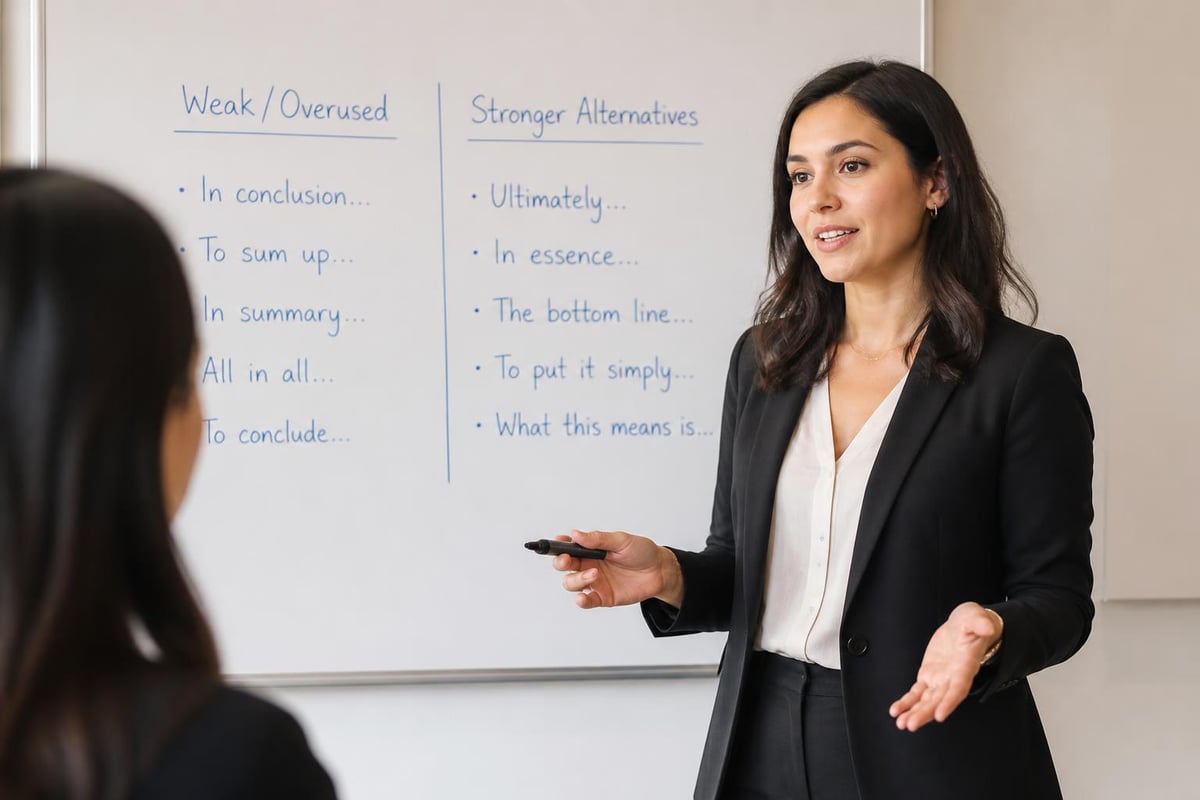
Research from transition words for conclusion paragraphs indicates that readers respond more positively to varied transitional language. Instead of defaulting to “in conclusion” for every piece you write, consider rotation among multiple options based on context.
| Weak/Overused | Stronger Alternative | When to Use Alternative |
|---|---|---|
| In conclusion | Ultimately | When emphasizing final judgment |
| To conclude | Given these insights | After analytical discussion |
| In summary | The key takeaway | Business or practical content |
| Finally | Most significantly | When highlighting importance |
Implementing Transitions Effectively
Simply inserting a transition word at the start of your conclusion paragraph doesn’t guarantee effective writing. The phrase must integrate naturally with your sentence structure and flow logically from your preceding content.
Placement and Sentence Structure
Good transition words for a conclusion typically appear at the beginning of the concluding paragraph, but they can also function effectively mid-paragraph or at the start of your final sentence. The key is ensuring the transition enhances rather than interrupts the reading experience.
Consider these placement options:
- Opening position: “Therefore, organizations must prioritize data security in 2026 and beyond.”
- Mid-paragraph: “Organizations face mounting cyber threats. Consequently, data security must become a top priority.”
- Final emphasis: “Data security, ultimately, determines organizational survival in the digital age.”
Each placement creates a different rhythm and emphasis. Opening position provides immediate clarity about the paragraph’s purpose. Mid-paragraph placement creates variety and avoids predictability. Final emphasis saves the transition for maximum impact.
Combining Transitions with Strong Content
Even the best transition word fails if the content following it lacks substance. Your conclusion must deliver meaningful synthesis, not simply repeat points already made. Guides on frequently asked questions about conclusion transitions emphasize that transitions serve the content, not vice versa.
Effective conclusion components include:
- Synthesis of main arguments
- Broader implications
- Call to action or next steps
- Memorable final thought
- Connection to opening hook
When working with AI-generated conclusions, students and professionals using AI detection tools should pay particular attention to whether the conclusion adds value beyond repetition. Strong transitions combined with weak content still produce weak conclusions.
Advanced Techniques for Conclusion Transitions
Once you’ve mastered basic transition usage, advanced techniques can further distinguish your writing. These approaches work particularly well in longer documents or when addressing sophisticated audiences.
Transitional Phrases vs. Single Words
While single-word transitions like “therefore” and “ultimately” work well, longer transitional phrases can create more nuanced connections. These extended phrases often better capture complex relationships between ideas.
Single-word transitions:
- Therefore
- Thus
- Consequently
- Finally
- Ultimately
Extended transitional phrases:
- Taking all of this into consideration
- Given the evidence presented
- Based on this analysis
- Considering these multiple perspectives
- In light of these findings
Extended phrases feel more conversational and less formulaic. They also provide more flexibility in sentence construction, allowing you to vary your rhythm and avoid monotonous patterns.
Creating Custom Transitions
Good transition words for a conclusion aren’t limited to standard phrases found in reference guides. Creating custom transitions tailored to your specific content demonstrates sophistication and attention to craft. Resources like conclusion transition words from Grammar Vocab provide foundations, but skilled writers build on these basics.
Examples of custom transitions:
- “With these three strategies in mind…”
- “Having examined both perspectives…”
- “After exploring these five approaches…”
- “Now that we’ve established the framework…”
- “Armed with these insights…”
Custom transitions reference specific elements from your content, creating tighter cohesion between sections. They demonstrate that you’re actively guiding readers rather than inserting generic phrases.

Common Mistakes and How to Avoid Them
Even experienced writers sometimes stumble with conclusion transitions. Recognizing common errors helps you maintain professional standards and avoid undermining your credibility.
Repetitive Transition Usage
Using the same transition word across multiple documents, or worse, multiple times within a single document, signals lazy writing. Readers notice these patterns, even unconsciously, and they diminish perceived expertise.
Solution: Maintain a transition word rotation list
Keep a document listing good transition words for a conclusion organized by category and formality level. Before writing, select which transition you’ll use for that specific piece. Track your usage across documents to ensure variety.
Transition Without Synthesis
The biggest mistake isn’t choosing the wrong transition but following any transition with weak content. A conclusion that merely repeats earlier points without synthesis wastes both the transition and the reader’s time.
Weak conclusion example: “In conclusion, we discussed marketing strategies, budget planning, and timeline development. These three elements are important.”
Strong conclusion example: “Given these insights, successful campaign launches require synchronized attention to marketing strategy, budget allocation, and timeline management. When these three elements align, organizations maximize ROI while minimizing execution risk.”
The strong version synthesizes the relationship between elements and provides actionable insight, not just repetition.
Tailoring Transitions for Different Audiences
Professional writers adjust their transitional language based on who will read their content. What works for academic reviewers may fall flat with business executives or general readers.
Academic Audiences
Academic writing favors precision and formality. Resources from First English Grade on transition words for conclusions emphasize that academic audiences expect traditional transitions that signal rigor and careful analysis.
Preferred academic transitions:
- In conclusion
- To conclude
- In summary
- The evidence indicates
- These findings suggest
- Based on this analysis
These phrases align with academic conventions while maintaining clarity. They also work well in research papers, dissertations, and scholarly articles where innovation in language matters less than precision in argument.
Business and Professional Contexts
Business readers value efficiency and actionable insights. Transitions should move quickly from evidence to practical implications without unnecessary academic formality.
Effective business transitions:
- The bottom line
- Moving forward
- Based on these insights
- The key takeaway
- Given this data
These phrases acknowledge that business readers want conclusions that inform decisions, not simply summarize information. They emphasize forward motion and practical application.
Content Marketing and Blogs
Content marketing allows the most flexibility with good transition words for a conclusion. Writers can choose transitions that match their brand voice while maintaining professional credibility. When creating content that will be humanized to bypass AI detectors, varied and natural-sounding transitions become especially important.
Measuring Transition Effectiveness
How do you know whether your chosen transition works? Several indicators help evaluate effectiveness beyond simple personal preference.
Reader Feedback and Engagement
If readers consistently disengage before reaching your conclusion, your transition may signal an ending they don’t find valuable. Analytics showing drop-off rates at conclusion sections suggest the transition isn’t compelling readers to continue.
Engagement indicators:
- Time spent on conclusion section
- scroll depth completion rates
- comments referencing conclusions
- social shares of complete articles
- bounce rate at conclusion start
These metrics reveal whether your transitions successfully guide readers to your final insights or inadvertently signal “skip this part.”
Clarity and Comprehension
Effective transitions improve comprehension by making relationships explicit. If readers misunderstand your conclusion’s connection to earlier content, your transition may be unclear or misleading.
Testing comprehension through feedback surveys or informal discussions reveals whether your transitions successfully communicate intended relationships. Questions like “How does the conclusion relate to the evidence?” or “What was the main takeaway?” help assess transition effectiveness.
| Assessment Method | What It Reveals | How Often to Use |
|---|---|---|
| Reader surveys | Comprehension clarity | After major publications |
| Analytics review | Engagement patterns | Monthly |
| Peer review | Professional perspective | Before important submissions |
| A/B testing | Comparative effectiveness | For high-stakes content |
Context-Specific Applications
Different writing situations call for different transitional approaches. Understanding these contexts helps you select the most appropriate phrase for your specific needs.
Short-Form Content
Blog posts, social media content, and brief articles need concise transitions that don’t consume valuable word count. Good transition words for a conclusion in short-form contexts should be efficient while maintaining clarity.
Best for short content:
- Ultimately
- Therefore
- The takeaway
- In short
- Simply put
These transitions signal conclusions without lengthy phrasing that might feel disproportionate to the content length.
Long-Form Documents
White papers, comprehensive guides, and extended research pieces benefit from more elaborate transitions that acknowledge the journey readers have taken through substantial content. Guides on conclusion transition words from English Grammar Notes emphasize that longer documents can support more complex transitional language.
Effective for long content:
- Having examined these multiple dimensions
- After this comprehensive analysis
- Considering all these factors
- Given the breadth of evidence presented
- Taking into account these various perspectives
These extended phrases feel appropriate for substantial content and help readers mentally shift from detailed exploration to synthesis.
Technical and Scientific Writing
Technical writing requires precision in transitions just as it does in content. Ambiguous transitions undermine the clarity that technical audiences expect and deserve.
Technical writing transitions:
- The data indicates
- These results demonstrate
- Based on these findings
- The analysis reveals
- Given these parameters
These phrases connect directly to evidence and methodology, reinforcing the scientific approach that characterizes technical content.
Practical Exercises for Mastery
Improving your use of good transition words for a conclusion requires deliberate practice. These exercises build skill through focused application.
Transition Substitution Exercise
Take a completed piece of writing and identify your conclusion transition. Rewrite the conclusion five times, each using a different transition from different categories (summary, logical consequence, emphasis, custom). Compare how each version changes the tone and emphasis.
Example transformations:
- Original: “In conclusion, remote work provides flexibility while maintaining productivity.”
- Summary focus: “To summarize, remote work provides flexibility while maintaining productivity.”
- Logic focus: “Therefore, remote work provides flexibility while maintaining productivity.”
- Emphasis focus: “Ultimately, remote work provides flexibility while maintaining productivity.”
- Custom: “Given these five case studies, remote work provides flexibility while maintaining productivity.”
This exercise reveals how transitions shape meaning beyond simply signaling conclusions.
Formality Matching Challenge
Write the same conclusion three times for three different audiences: academic reviewers, business executives, and general blog readers. Use appropriate transitions for each context.
This challenge builds awareness of how audience expectations shape language choices. It also creates a mental library of transitions organized by formality level, making future selection more intuitive.
Mastering good transition words for a conclusion transforms your writing from merely competent to genuinely compelling. By selecting transitions that match your content type, audience expectations, and specific purpose, you guide readers seamlessly from evidence to insight. Whether you’re crafting original content or refining AI-generated text, these transitional phrases ensure your conclusions feel natural and authoritative. Top Humanizer helps content creators transform AI-generated conclusions into humanized writing that maintains perfect flow while bypassing AI detection tools, ensuring your carefully chosen transitions work within completely authentic-sounding content.